

When organisations first try to govern AI use, the instinct is to record everything: every prompt, every attachment, every response, all in one searchable place. It feels like the safe choice. If something goes wrong, the answer will be in the logs.
In practice, a central archive of everyone’s AI conversations is one of the most sensitive data stores an organisation can create. It concentrates client information, personal data, draft positions and privileged material from every team into a single system, often with broad administrative access and unclear retention. It can make the risk it was meant to reduce larger.
There is a better question to start from: what do you need to be able to prove?
Start from the questions oversight has to answer
Most governance questions about AI use are questions about decisions, not about content.
- Which approved models were used, by whom, when and how much?
- Which policy applied, and in which version?
- Was anything refused, held for approval or changed by protection before it left?
- Who approved a consequential action, and what exactly did they approve?
- Did a disabled model or provider stay disabled?
Decision records can support these questions within the boundary they observe. Assess collection coverage, actor attribution and links to actual actions before drawing a conclusion. Some questions still require authorised access to source material.
What a decision record can contain
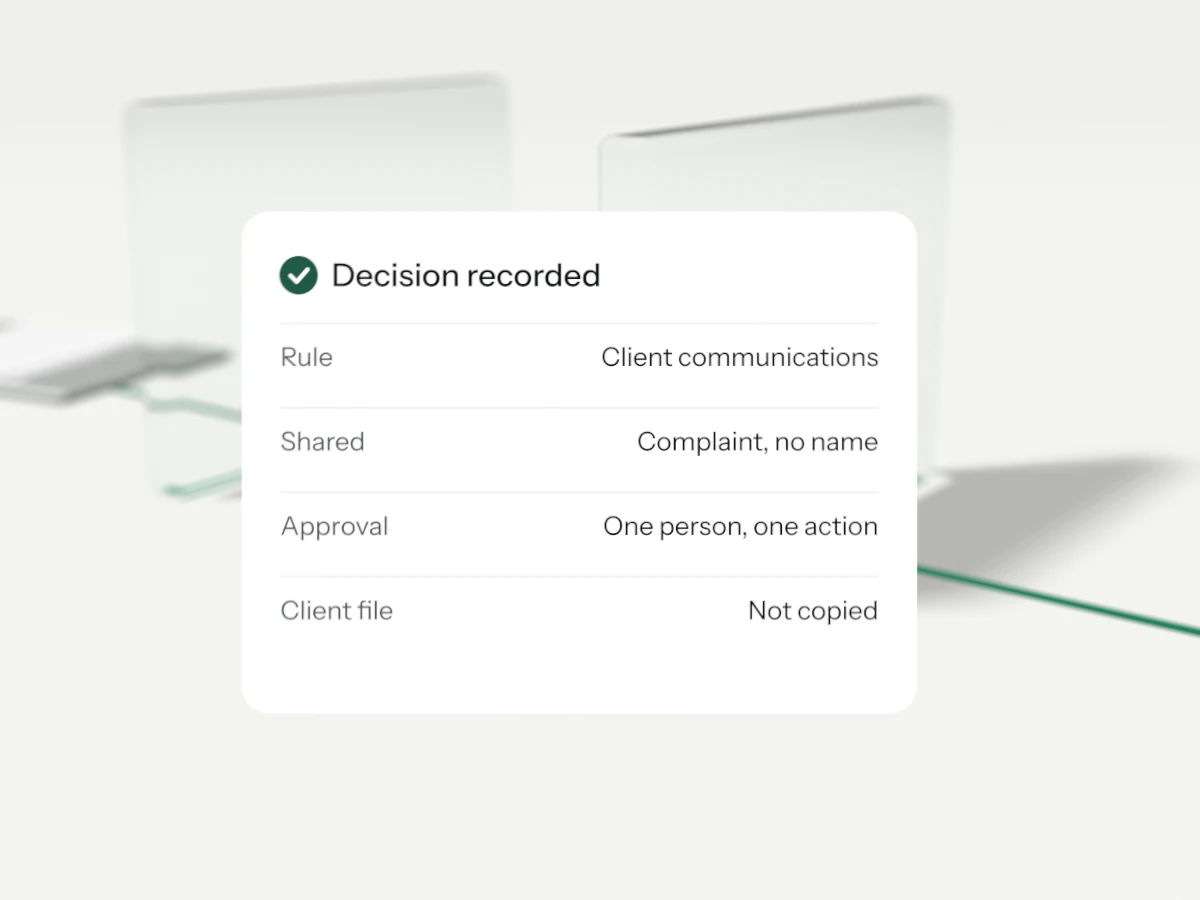
A well-designed record of an AI decision captures facts about the decision and fingerprints of what was decided on, rather than the material itself.
| Useful in a decision record | Better kept out of it |
|---|---|
| Who acted, on which device, at what time | The prompt text and attachments |
| Which provider and model, and whether they were approved | The model’s response |
| The policy and its version | Protected values that were tokenised |
| The outcome: allowed, protected, held, refused | Re-identification mappings |
| A hash of the exact payload or approved action | Provider credentials |
| Usage and estimated cost | Free-text “reasons” copied from content |
A cryptographic fingerprint supports comparison with a candidate payload when the hash method and exact representation are known. It cannot reconstruct the content, establish who created it or prove that every event was observed. Predictable content may also be guessed and checked against a hash. Keep those limits separate from the integrity protections on the record itself. The worked decision-record resource shows how to assess these gaps.
Keep content where it already lives
Content does sometimes need to be reviewed: a disputed output, a complaint, a supervisory request. The question is where that content should come from. Usually the right answer is the place it already lives, under the access controls, retention rules and legal holds that already govern it, rather than a second copy in the AI control’s logs.
Our vision for Synainesi is oversight without a central archive of everyone’s work. Guard is designed to produce decision evidence that minimises personal data. Cloud Admin is designed around metadata: who used which approved model, when, how much, at what estimated or reported cost, and with which policy outcomes. Our intent is to keep raw work content on the device by default and give Cloud Admin no path for ingesting raw prompts, documents, protected values or mappings. Every persistent store is intended to have a defined purpose, owner, retention period and deletion path.
Evidence has its own obligations
Metadata is not automatically harmless. Records of who used which tool, and when, are themselves personal data about employees, and can be misused for monitoring that goes well beyond governance. The same discipline applies to evidence as to content: collect what the stated purpose requires, restrict who can see it, keep it only as long as needed, and be clear with employees about what is recorded and why.
The European Commission’s explanation of GDPR principles sets out purpose limitation, data minimisation, storage limitation and accountability. Those principles support a disciplined question for each evidence field: why is it needed, who should see it, and when should it be deleted?
A short test for any AI control
- Can you answer the five oversight questions above without reading anyone’s prompts?
- Does the control keep content by default? If so, who can read it, and when is it deleted?
- Can a record prove which payload a decision applied to without containing it?
- Is every store in the control documented with a purpose, owner, retention and deletion path?
Good evidence makes oversight possible. Surveillance makes it expensive, and sometimes makes it the problem.
Related: the principles behind Synainesi, and what tokenising a prompt does and does not do.
Put the ideas to work
Use these ungated tools without any particular product: AI decision records and their limits · Article 4 literacy measures and evidence. Explore all AI governance resources.
Insights are general commentary on governing AI. They are not legal, regulatory, tax or security advice.